Showing posts with label David Allen. Show all posts

Wednesday, August 13, 2008

David Allen Stopped By...


I am experiencing a "Holy Smokes" moment right now. I just stopped by at the comments section of my latest article at the GTDtimes, which is about how...

...the smartest people are the ones that realize that they have a big, powerful, dumb part of themselves that has a whole lot to do with what they do. They structure their lives in a very intelligent way that manages the dumb and powerful part. The dumb people think they're smart all the time.

I was just checking in to see if any new comments had popped up. I do this from time to time as the notification system for whatever reason only works inconsistently. And sure enough there is a new comment there...but it is by...get ready for it...David Allen. Really.

For anyone who is not a GTDer (I won't be mean and say, who lives in a cave), this would be a bit like having a Mac zealot write a blog entry about some thoughts on the Mac OS. And suddenly Steve Jobs drops by to say, "Hey, nice write up. I enjoyed your ideas. Let's touch base sometime." And you rub your eyes, and it's actually still Steve Jobs.

So have a peek at the Big Kahuna's comment and enjoy my moment with me. And by the way, the part in italics is not my summary of my article. That is David Allen's thumbnail of it from the comment he left. It's always nice to get a reader who gets the gist of your article. But you don't really expect to have the guy whose extraordinarily successful system you're writing about stop by to say hello, much less to have clearly read your piece. That's not to say I didn't have a very distant hope for it...but I certainly didn't expect it.

And it's nice when life drops these unexpected moments in your lap from time to time.

Thursday, July 31, 2008

GTDtimes Article: Ancient Cheating and a Modern Twist


I was surprised this morning to see my second article already posted over at the GTDtimes, exploring how writing can be used to "cheat, and increase our cognitive capacities in two different ways, both powerful.  David Allen often refers to this as clearing out our "psychic RAM". I mentioned previously that I am pleased to have been taken on as a regular contributor to their well known productivity blog.

Image courtesy of "cheetleys" over at Flickr

Wednesday, July 30, 2008

Easier or More Difficult?

I've talked before about how I think that Getting Things Done and Love and Logic function in similar ways by helping to distill the chaotic into the manageable. Getting Things Done does its distilling magic in areas from tracking and paying bills, to managing work projects, to planning birthday parties. Love and Logic does its transformation with everything from having heart to hearts with your child, handling the stolen item found in the backpack, to teaching kids about demonstrating some appreciation for their parent's contributions around the household. Because I think they are doing some sort of similar process, I would predict that you're going to find some ideas from each model that apply to the other. Well here's one that I've noticed that comes from David Allen. He says that implementing GTD is both easier and more difficult that you would respect.

"...both easier AND more difficult than you would expect"
David Allen

Now that is a bit of a paradox, AND I think its true. It is likely true of each model in similar ways. The easiest part has to do with what David Allen calls advanced common sense. Like with Love and Logic people say to him from time to time, "Well this is just common sense." And they are simultaneously right and wrong. It is common sense. Take for example always identifying a next action for any item on what would be more commonly called your To Do list. Once you get in the habit of it, it really does come to make sense and you might wonder how you used to do without it. The part that is wrong is the "just" in the sentence. It is common sense, but not just common sense. David Allen uses the term "advanced common sense" to describe it. I pointed out in a my first post over at GTDtimes that social psychologists might be more apt to call it hindsight bias, the illusion that what you know now, you must have known all along. Or there's a corollary I've added, which is What I know now must have always been very easy to come up with. Well, maybe not. But the fact is that we very rarely if ever do come up with these models on our own. And though we often do it, it doesn't really make much sense to hold ourselves or others accountable for information they couldn't have had at the time. This is a very common phenomenon with Love and Logic. I hear parents make similar statements all the time along the lines of "It only makes sense" or "I can't believe I didn't think of that.

So the easier part I think is that the principles are pretty straight forward. They aren't terribly complex. In fact that is actually part of the beauty of both models. You don't have to memorize ultra complex procedures, and when you break down the ideas, virtually anyone can get them. How about the more difficult part? What is more difficult than we might expect is that given how the ideas are relatively easy to grasp, it is surprisingly more difficult to put them into action that you might expect.

This has to do with why I was taken on as a contributor over at GTDtimes. Part of what the executive editor is wanting me to provide for readers is how our brains interface with the Getting Things Done model. In other words, what about cognitive psychology might explain why the principles work as they do. The reason things are more difficult comes largely down to two things. First it comes down to neural plasticity, which is neurospeak for the way that our brains change as you learn. The fact is that learning is a physiological process. And much of that learning actually takes time to chemically and neurologically alter the brain so that that learning stays long term.

A hugely common phenomenon is in coaching is that parents are surprised when they understood a principle in session, and were excited about it, but then they go home and do the same old ineffective thing and just yell at the kids, for instance. To me it is predictable, because I know that it just takes time, and one other key ingredient, repetition. Now lots of different things can work as repetition. First, they could hear about the technique several times in several different contexts. Often I encourage parents to listen to CDs about the Love and Logic techniques for exactly this reason. Another ways is by reflecting on what occurred when it doesn't go well and tying it in with the new learning. Another way to put this is to say that Awareness is the first step. I literally tell parents to expect that even though they fully got the concept of say, enforceable statements, to expect they will go home and blow it. That is why it is essential that they consider awareness progress. If they set the bar at going home and nailing right off the bat, the predictably run off the rails in short order.

So the good news is both programs are easier than you would expect. I've seen people transform their lives both in the areas of parenting and in "stress-free productivity". And the bad news isn't so bad. If you know the little bit about brains and learning that I just shared and you can fully accept that, it actually won't be much more difficult than you expect...or that's my prediction anyway.

If you enjoyed this article please vote for it on Digg, above, or Netscape or one of the other options below. You can also bookmark the site to the right. I appreciate your support.
Sunday, April 27, 2008

Merlin Mann and the 43 Folders


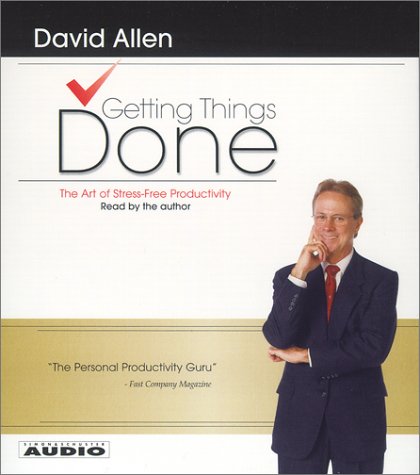
I can't believe that I'm writing more on Merlin. I am fascinated with his site 43 Folders. I am growing to really love this guy's nerdy, offbeat and tenacious approach to getting organized. I've posted before about finding the ideas that David Allen outlines in his book Getting Things Done very useful. But there is a formality about it that seems to be aimed at business folks that just isn't nearly as fun as Merlin Mann's quirky take on productivity.

What's to Love
  • He talks about all the struggles and foibles of chasing after the latest "hacks" (shortcuts or approaches). He is a quirky guy who uses catchy slang and has a predilection for wearing gas station coats and hip glasses.
  • Merlin has a young daughter, which makes his quest for a reasonably organized life all the more realistic for all of us who are parents.
  • His goal is not productivity for productivity's sake or aimed at the common theme in the productivity literature on getting wealthy or becoming powerful. He does talk about how to make more money more easily and how to become more influential, but it is not because money is the priority. Any focus on money is in service of living a full, meaningful, enjoyable life where you can focus on the things that matter most to you.
  • It is productivity in service of living a meaningful, enjoyable life.
  • Humor is sprinkled liberally throughout the site. For some, this could be a downside if your sense of humor is not a match with his. But I think for most folks, it makes his site approachable. You learn about how to be more productive, but it feels like you're playing when you're learning about it.
  • There are tons of very practical recommendations on everything from filing accouterments to the best pens to easy to use software that fits in with his approach. We even bought a little flip video camera based on his recommendation.
  • There are multiple ways to enjoy the content. Throughout the site you can find links to other useful sites, to books that look at things more in depth, to The Merlin Show, where Merlin interviews different folks about their approaches to creativity and productivity. There are also videos of full blown presentation. Some of those I wish showed a little more of him, and a bit less of his presentation slides, but they are still good.
  • He has All Time Most Popular Posts and Classics links right at the top of the home page, so that new visitors can immediately dive in to the most powerful concepts (or the funniest stuff).
What's Not to Love

About my only gripe really isn't much of a gripe. I just wish there were even more content being added since I'm getting so much out of it. This seems a bit like criticizing a delicious meal because it makes you want to eat more.

PS I hate the way this Blogger software messes up the spacing after you make a bulleted or numbered list. Not sure if this is a Mac only problem. I am on Fire Fox. Anyone else run into this problem? I'll have to check on our PC to see if it looks the same there. Anyway, I am hoping that this is one of the things that gets taken care of with my site refresh, getting a blog hosted on my own domain. Don't worry I'll make sure there are links from the current site so you can keep in touch.

Tuesday, April 15, 2008

Useful Site / Email Ninja Skills

Time for a next installment on Getting Things Done (GTD). It is becoming increasingly clear that one of the top challenges of our age is sifting through information to mine out what we need. How do you sort through all the junk and marginally useful info to get to the handful of gold? How do you face all piles of paper, or the heap in your inbox to end up with practical, useful information that you can find at the moment it is required?

There are many sites that discuss the GTD principles and share tips and tricks for making life's stuff * easier to handle. But the one I've come across that is the most fun and that is most useful for me so far is 43folders.com. What I like in addition to keen advice by Merlin Mann, a productivity expert in his own right, is that the site takes a community approach where people chime in and share their personal takes on how to implement the principles. The great thing is that though people are able to post, the site still is nice to look at, unlike a lot of bulletin board themed sites. It also appears that there must be some sort of editing process, because I've not yet run into anything that seems off topic or distracting. There is a lot of humor used to keep things light and playful, but be warned, at times it can be a bit crass, if funny. Nothing beyond what you'd see at a PG movie though.

Email is one topic that gets a lot of play on 43folders since it has become a primary means of communication, and a source of a huge amount of our information. So how do you become an email Ninja who can effectively take care of business, and not end up with a very organized maze of folders where your need info gets placed, never to be seen again? This article Five Fast Email Productivity Tips is a good place to begin. My guess is that many of you will end up following links until you've bumped into the areas you most want to go more smoothly. Don't forget to come back and visit Awareness * Connection. In fact, go ahead and put that on your "Soon" next action list.

* David Allen defines "stuff" in GTD as anything that you have allowed into your physical or psychological world that you haven't yet figured out how and when to take action on, or with.

Friday, March 28, 2008

Getting Things Done: Taxes & Root Canals


Taxes are finally complete, sent off through cyberspace and satisfyingly checked off my Getting Things Done (GTD) list**. Getting tax stuff done with a lot less stress is one of many examples of how tedious chore type stuff has gone more smoothly for me since I've been using the system...and I have to say, I don't tend to be much of a personal organization "system" type of guy. If I'm able to use it productively, that means that most people would be successful with it. Anyway, getting taxes for the season wrapped up and turned in always feels good no matter what the news turns out to be. Completing taxes happens to be one of the year's bigger "closed loops" for me, as David Allen would put it. And I know from what clients and friends report that I am not the only one who finds it a biggie. Allen describes "loops" as those unfinished tasks, chores, plans, etc. that take up our mental RAM when we haven't taken the time to mentally download them into our system, with the next physical action to be taken identified (the key to having your mental RAM free for creativity, better decision making, and just enjoying yourself).

A couple days ago Erin, my wife, told me that she ended up with both our accountant appointment and her root canal slated for the same day. Instead of Ben Franklin's familiar quip "death and taxes" being the only certainties in life, it's "dental work and taxes". Seems equally true, doesn't it? And maybe one notch less depressing. Anyway, her day was not one most of us would be looking forward to on own calendars. She ended up having a pretty good day all in all, though she did say there was a bit of shoe shopping toward the end of the day for self-soothing purposes. Though I'm sure that the shoes helped, I think something else was going on with her good mood after a day of serious dentistry and reckoning with Uncle Sam. And I think it illustrates a truth that's worth reflecting on. It's based on a tidbit I learned about years ago from from Mihaly Csikszentmihalyi (there will be a spelling test at the end of this post) the expert on the major part that flow experiences contribute to our overall happiness. The tidbit is that getting an unpleasant chore done tends to leave us relaxed and with a sense of happiness, whereas engaging in some sort of passive entertainment like watching television leaves us on average in a lower mood by the time we're done. In fact with television (again, on average) the more of it we watch, the worse we feel. Getting something out of the way on the other hand just feels good. By the way, Csikszentmihalyi's info is based, among other sources, on his now famous study where he hooked grad students up with beepers and paged them throughout the day reminding them to record their moods in real time during their normal activities.

Somehow this post that was just supposed to be a quick quip on "dental work and taxes" has become my intro post for Getting Things Done as well, as a tidbit about flow. I guess it is good to get it out there since I think most of my clients, as well as the small contingency of readers of Awareness * Connection around the globe, would find that GTD helps with making life a bit smoother right away. And "a bit smoother right away", is a phrase that is pretty central to the work I do with most clients. If you often find yourself feel stressed out about what you have coming up, I think you stand a good chance of reducing your stress level a good deal by experimenting with GTD and adopting the pieces that fit for you.***


Extras
**I do my work on a Mac so I use an Omni Group version of Getting Things Done called Omni Focus, but on David Allen's site, he sells Windows compatible versions of his system on software. The same version is also compatible with Macs. It is worth noting that Getting Things Done can be done in any medium. You could do it on 4 x 6 cards, in a Moleskine notebook or on a fridge with sticky notes. But as with many other tasks the computer lends itself to your system being a bit more lean and clean. The only downside being that you'll want to back up your data regularly. I just visited Allen's website and he now has detailed tips available (whitepapers) about using Outlook, Entourage and Lotus Notes effectively with the Getting Things Done system. His empire seems to be steadily growing. Looks like his system is working for him anyway.
***I don't work for or with David Allen. I'm genuinely enthusiastic about the effectiveness of the system. No kickbacks. Wouldn't be ethical to combine an arrangement like that with therapy...not that Mr. Allen has ever had such an arrangement with me on his GTD list.
****Okay, quick. How do you spell the name of the author of Flow? 'Told ya it'd be here.

If you enjoyed this article please vote for it on Digg, above, or Netscape or one of the other options below. You also bookmark the site to the right. I appreciate your support.