Saturday, August 16, 2008

Reference: The Attention Principle


I had to define this for another post, and it deserves its own post at minimum for now.

The Attention Principle:
Any behaviors which we react to with energy, attention or emotion, we tend to see more of.

This principle explains why yelling, reminders, and even excessive "helpful" explaining yield the counter intuitive result of more of the same problematic behavior.

This principle is worth several posts in the future, but I wanted it up here for reference in the meantime. If you want a longer description of it for now, you can find that on p. 3 of this handout from my practice website.

The Preschool Whisperer


I've had more than one client spontaneously refer to Caesar Millan, The Dog Whisperer on National Geographic in reference to staying calm when interacting with preschool aged children. Both of these parents, and I as well, are clear that working with dogs is not the same as working with kids. But there is a powerful metaphor available in thinking about Caesar. On his show he frequently refers to the idea of Calm, Assertive Energy, as way of being around dogs that helps them to calm down and follow his lead. In very brief interactions with a problem, aggressive dog, you can often see the change in the dog's body language seconds after he enters the scene. The dog is in tune with the way he carries himself.

This Caesar metaphor nicely captures a concept that I've had a clear image in my mind about how it looks, but have some trouble communicating. I think the folks at Love and Logic have had the same challenge. It is much easier to describe the techniques than it is to capture the subtle way of being with kids, yet I think the idea is essential.

After reading some of Wayne Dyer's older books I adopted for some time his phrase of "quietly effective" practices. You'll notice one of the pdf handouts on the Enjoy Parenting Again site is titled Quietly Effective Techniques for Working with Preschoolers and Toddlers. 

This idea of calm-assertiveness is a state of mind in which you are responsive, but not reactive. Where you hold yourself in a way that communicates to the child that "I can handle the situation and help you, and I can even handle you if needed." This way of holding one's self helps kids to be calmer and to feel safer, especially when they are melting down. Often instead we can become reactive or aggressive sounding. But this "I've had it" stance communicates something very different, along the lines of "I'm not really in control here. I'm powerful, but just barely managing myself." When kids are around this they often feel unsafe and act out even more. Or the attention principle comes into play.

More on this in future posts. For now I'll just say that my clients have been the source of many powerful ideas I've come across. This is one I'll be hanging onto. 

Wednesday, August 13, 2008

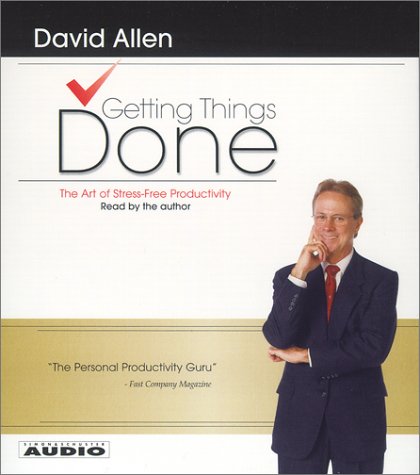
David Allen Stopped By...


I am experiencing a "Holy Smokes" moment right now. I just stopped by at the comments section of my latest article at the GTDtimes, which is about how...

...the smartest people are the ones that realize that they have a big, powerful, dumb part of themselves that has a whole lot to do with what they do. They structure their lives in a very intelligent way that manages the dumb and powerful part. The dumb people think they're smart all the time.

I was just checking in to see if any new comments had popped up. I do this from time to time as the notification system for whatever reason only works inconsistently. And sure enough there is a new comment there...but it is by...get ready for it...David Allen. Really.

For anyone who is not a GTDer (I won't be mean and say, who lives in a cave), this would be a bit like having a Mac zealot write a blog entry about some thoughts on the Mac OS. And suddenly Steve Jobs drops by to say, "Hey, nice write up. I enjoyed your ideas. Let's touch base sometime." And you rub your eyes, and it's actually still Steve Jobs.

So have a peek at the Big Kahuna's comment and enjoy my moment with me. And by the way, the part in italics is not my summary of my article. That is David Allen's thumbnail of it from the comment he left. It's always nice to get a reader who gets the gist of your article. But you don't really expect to have the guy whose extraordinarily successful system you're writing about stop by to say hello, much less to have clearly read your piece. That's not to say I didn't have a very distant hope for it...but I certainly didn't expect it.

And it's nice when life drops these unexpected moments in your lap from time to time.

Tuesday, August 12, 2008

Merlin Mann and the 90 second GTD Primer


I don't usually just provide a link to a posting, but this one by Merlin Mann on GTD contexts was stellar for its brevity, wit and usefulness. It includes a 90 second GTD overview—very handy in and of itself, an exploration of why GTD contexts are so damn useful, and a quip that made me actually laugh out loud. If that isn't enough to warrant a link to another post, I don't know what would be. 

Sunday, August 10, 2008

Second Children Change How Parents View Parenting


Many people have noticed the tendency for parents to lighten up quite a bit after their first child. With our first born we tend to be tentative and err toward over-caution. I often hear the explanation for the change in behavior that the parents realized that their first child turned out okay despite the bumps and scrapes both figurative and literal. They've discovered that babies and children are pretty hearty, and treading on eggshells isn't required.

The thought occurred to me today that I think it goes a bit further than this. It has to do with this notion that I heard that first-time parents tend to be big believers in nurture. Parents with later-born children tend to be believers in nature. That is, they realize that very important traits central to who their children are that are not at all determined by how they were parented. When the second child arrives, they notice that she is often completely different in traits ranging from how easily startled the child is to how she responds to new stimuli. So this realization can occur within hours of the birth of the second child. The parent realizes, "There was no time for parenting to bring about these traits in our newborn. There has to be something about the child herself that makes her different."

Of course the question of whether nature or nurture rules the roost of who our children become is a false one. The science is absolutely clear that both are at play. I do think though that our culture errs way too far these days on the side of believing that it is always the environment that is responsible for how the child turns out.

In an upcoming post, I will describe the nine dimensions of temperament, the traits that research has shown that we are born with, and that are not determined by our family of origin.

In the meantime, what traits does your children have that you suspect they were born with?


Thursday, August 7, 2008

iDog, and Up and Out of the Tween


My daughter has extended her ability to delay gratification. We give her an allowance weekly and we offered to match whatever she saved for a recent vacation she and her mother took. And she kept the bulk of her money in her pocket during the vacation and decided that she'd rather get her first iPod than collect souvenirs. I was very glad to see her pull that off. Delayed gratification is a cornerstone of emotional intelligence, and it is challenging to teach. 

Since she's only eight I'm happy that iPods now come with volume limiting capability, mainly to keep her from accidentally turning the iPod up way to loud. Those Nanos have touchy little click wheels these days. Also Hannah is not as good as some kids at monitoring that sort of thing carefully. 

Now here's the catch. She had some money left over and decided she had to get an iDog to go with her new mp3 player. Now I'm not quite as impressed with iDog as she is. He pretty much is simple robotic external speaker; produces light patterns on his muzzle to beat of music; and occasionally moves his head back and forth and wiggles his ears. That's iDog. So much for the delayed gratification piece. And for iDog to work, we've discovered, the volume on the iPod has to be cranked up way beyond the sub-half point we set on the volume limiter to preserve her hearing for future years. My hearing, by the way, isn't great, and she may be up against a genetic component too. 

I'm afraid when she's done with iDog one of these times, she'll put on those earbuds, blasting her hearing before I get a chance to reset the volume limit. It doesn't take too long to do some permanent damage. So at this point, my options seem to be  1) ban iDog,  2) throw my hands up in the air and say to myself "I guess she's almost a teen. Whaddaya gonna do?" or 3) lecture her on how delicate hearing is—try to impress upon her how important it is to make sure that she always brings one of us the iPod immediately after using it with iDog, so we can reset the volume limit again.

At 8 years old she has been cultivating that tween skill of giving off disgusted facial expressions when she doesn't like what is being said. The up side is that I have a lecture early warning sign telling me when what I'm saying just isn't likely to sink in. One of the best things I know of to help in this situation is Up and Out of the Kid. It isn't that far off from lecturing, but it is different enough that it improves on it in a couple of ways. The first way is by changing my tone so that she is better able to hear what I have to say. When we lecture, we have a tendency to lapse into being condescending. If we start catching the eye rolls and facial expressions, it can rapidly go downhill from there. We get triggered, and out it rolls: "If you're not willing to listen to me about this without the attitude, maybe you're just not ready to have an iPod." So we're off to threats, and the unstated, embedded message we send is You're Not Capable.

So with Up and Out of the Kid, I try for something more along these lines. "So Hannah, if you forget to bring us the iPod and you end up with the volume too loud, for too long, what could happen?"
"It could ruin my ears"
"Yeah. And if that happened, how long would your hearing be hurt for?"
"It could be hurt forever"
"Right"
"So after you use iDog, what do you always need to do?"
"Bring you my iPod so you can do the noise thingy [volume limiter]"
"Good thinking.  And if you're not remembering to do that, what do you think we'll need to do?"
"Not let me use my iPod."
"Right. You'd be taking a break from it for a bit. So is that something it would help to write yourself a note about, or is that something that you could just remember on your own. What is your thinking on that?"
"I can remember." [self given You're Capable Message]
"That would be great. I bet you can too."

Up and Out of the Kid is not perfect, but in my mind it beats lectures and threats by a long shot. One of the advantages is that instead of bouncing off Hannah's cranium, which is what seems to happen when I lapse into lecturing, the ideas come up and out of her nervous system. And by definition that increases the odds that she's actually going to remember to do what she's saying. Also, you'll notice lots of my saying "Right" and "Good thinking" in these sorts of conversations. Where the unstated message of a lecture is, "You're not very sharp, so I'd better spell it out for you." the embedded message in a conversation using Up and Out of the Kid is more along the lines of, "This is important stuff. And I bet when you give it some thought you'll know how to handle it." An added bonus is that since by answering my question she stated the likely logical consequence of not bringing me the iPod, she is not going to be too shocked if that comes to pass. She'd still get hacked at me, but not in the same way since she was able to predict what would happen herself. 

I'm betting she'll do well with this. God they grow up fast. 

This is Your Elephant on GTD. Any Questions?

I was going to forgo posting this feature article I wrote for the GTDtimes, but I've been getting a good response to it over there so I thought it deserved a brief mention here. Though the piece is aimed at Getting Things Done, it actually is about essential knowledge for acquiring any complex skill. 

The article is about the way that our automatic and unconscious processes tend to wander off in a different direction than the goals we deliberately se, and that we may very much want to achieve. Our conscious desire to learn the skill is like the rider on an elephant. And the unconscious part that keeps us from going to the gym or from using a new parenting skill, even when we fully intend to follow through, is like an elephant the rider is perched upon. The only way this gigantic beast can be influenced is by training and repetition, as it very much has a "mind of its own". And getting angry with it or berating it is pointless.